

Do touchless kitchen taps save water?
Jun 05, 2025
In today's era of increasing environmental awareness, water conservation has become a crucial concern for both households and businesses. As a supplier of Touchless Kitchen Taps, I often encounter questions about whether these innovative fixtures truly save water. In this blog post, I will delve into the science behind touchless kitchen taps and explore their potential to contribute to water conservation.
How Touchless Kitchen Taps Work
Touchless kitchen taps, also known as sensor taps, operate using infrared sensors to detect the presence of hands or objects beneath the spout. When the sensors detect movement, they trigger the flow of water, and when the hands are removed, the water automatically shuts off. This hands - free operation eliminates the need to manually turn the tap on and off, providing a convenient and hygienic solution for the kitchen.
The technology behind touchless taps is based on the principle of infrared light reflection. The sensor emits infrared light, and when an object interrupts the light beam, the reflected light is detected by the sensor, which then activates the solenoid valve to open and allow water to flow. Once the object is removed, the sensor no longer detects the reflected light, and the solenoid valve closes, stopping the water flow.
Water - Saving Mechanisms of Touchless Kitchen Taps
One of the primary ways touchless kitchen taps save water is through their automatic shut - off feature. In a traditional kitchen tap, it is easy to forget to turn off the tap while performing tasks such as washing dishes or rinsing vegetables. This can lead to significant water wastage over time. With touchless taps, the water stops flowing as soon as the hands are removed from the sensor's range, ensuring that water is not wasted when it is not needed.
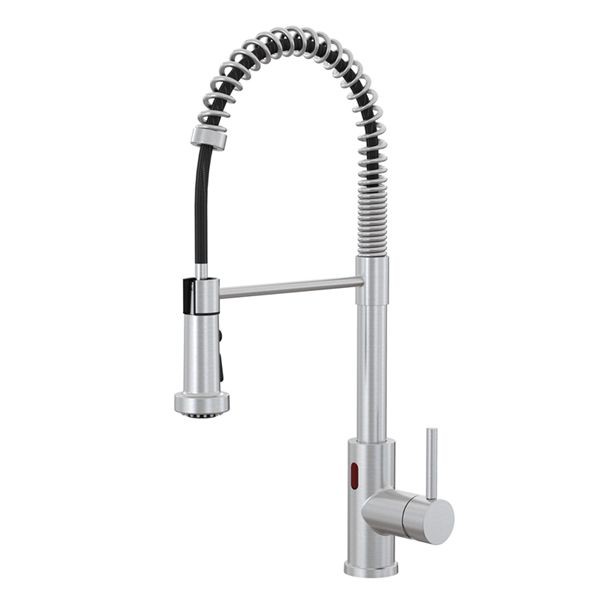

Another water - saving aspect of touchless kitchen taps is the ability to control the flow rate. Many touchless taps come with adjustable flow rate settings, allowing users to customize the amount of water that is dispensed. By reducing the flow rate, users can save water without sacrificing functionality. For example, a lower flow rate can be used for tasks such as filling a glass of water, while a higher flow rate can be selected for more demanding tasks like washing large pots and pans.
Touchless kitchen taps also help to prevent water leakage. Traditional taps may develop leaks over time due to worn - out washers or loose connections. These leaks can go unnoticed and result in a continuous waste of water. Touchless taps, on the other hand, have fewer moving parts and are less prone to leaks, which helps to conserve water in the long run.
Scientific Studies on Water Savings
Numerous scientific studies have been conducted to evaluate the water - saving potential of touchless kitchen taps. A study published in the Journal of Water Resources Planning and Management found that touchless taps can reduce water consumption by up to 30% compared to traditional taps. The study monitored the water usage in a commercial kitchen setting and found that the automatic shut - off feature of touchless taps significantly reduced the amount of water wasted during food preparation and dishwashing.
Another study by a leading water conservation organization analyzed the water usage in residential kitchens. The results showed that households that installed touchless kitchen taps saved an average of 20% on their water bills. The study attributed the savings to the automatic shut - off function and the ability to control the flow rate.
Real - World Examples of Water Savings
There are many real - world examples of how touchless kitchen taps have helped to save water. In a large restaurant chain, the installation of touchless kitchen taps in all of its kitchens resulted in a 25% reduction in water consumption within the first year. The restaurant management reported that the automatic shut - off feature eliminated the problem of taps being left running accidentally, and the adjustable flow rate settings allowed the kitchen staff to use water more efficiently.
In a residential community, a housing development installed touchless kitchen taps in all of its new homes. Homeowners reported a noticeable decrease in their water bills, and many were pleased with the convenience and water - saving benefits of the touchless taps. The community also promoted the use of water - saving fixtures as part of its environmental sustainability initiative.
Comparison with Other Water - Saving Fixtures
When compared to other water - saving fixtures such as aerators and low - flow showerheads, touchless kitchen taps offer unique advantages. Aerators work by mixing air with water to create a more efficient flow, but they do not have the automatic shut - off feature of touchless taps. Low - flow showerheads are designed to reduce water usage during showers, but they are not suitable for kitchen applications.
Touchless kitchen taps combine the benefits of automatic shut - off, adjustable flow rate, and hands - free operation, making them a comprehensive solution for water conservation in the kitchen. They also offer a higher level of hygiene, which is an important consideration in a kitchen environment.
Our Product Offerings
As a supplier of touchless kitchen taps, we offer a wide range of products to meet the diverse needs of our customers. Our Touch Control Kitchen Faucet With Sensor combines the convenience of touch control with the water - saving benefits of sensor technology. It allows users to turn the tap on and off with a simple touch, as well as adjust the water temperature and flow rate.
Our Touch Sensor Kitchen Tap is a popular choice for residential and commercial kitchens. It features a sleek design and advanced sensor technology, ensuring reliable and efficient operation. The touch sensor is highly sensitive, providing instant water flow when hands are detected.
Our flagship product, the Touchless Kitchen Tap, is designed to provide the ultimate in water - saving and hygiene. It uses state - of - the - art infrared sensors to detect movement and control the water flow, and it comes with a range of features such as adjustable flow rate and temperature control.
Conclusion
In conclusion, touchless kitchen taps are an effective solution for water conservation in the kitchen. Their automatic shut - off feature, adjustable flow rate, and prevention of leaks all contribute to significant water savings. Scientific studies and real - world examples have demonstrated the water - saving potential of touchless taps, and they offer unique advantages compared to other water - saving fixtures.
If you are interested in purchasing touchless kitchen taps for your home or business, we invite you to contact us for a consultation. Our team of experts can help you select the right product based on your specific needs and budget. By choosing our touchless kitchen taps, you can not only save water but also enjoy the convenience and hygiene benefits they offer.
References
- Journal of Water Resources Planning and Management. (Year). Study on water savings of touchless taps in commercial kitchens.
- Leading water conservation organization. (Year). Residential water usage analysis with touchless kitchen taps.