

What is the touch response time of touch sensitive faucets?
Aug 25, 2025
In the modern era of home improvement and kitchen innovation, touch sensitive faucets have emerged as a game - changer. Their sleek design and user - friendly features have made them a highly sought - after addition to kitchens and bathrooms around the world. As a dedicated supplier of Touch Sensitive Faucets, I often get asked about one crucial aspect of these faucets: the touch response time.
Understanding Touch Response Time
Touch response time refers to the duration it takes for a touch sensitive faucet to start or stop the flow of water after a user touches it. It is a critical parameter as it directly impacts the user experience. A fast response time means that when you touch the faucet, water starts flowing almost instantly, and when you touch it again to turn it off, the water stops immediately. On the other hand, a slow response time can be frustrating, causing delays in getting water when you need it and potentially leading to water wastage.
The touch response time of touch sensitive faucets is influenced by several factors. One of the primary factors is the type of touch sensor technology used in the faucet. There are different types of touch sensors, such as capacitive sensors and resistive sensors. Capacitive sensors are more commonly used in high - end touch sensitive faucets due to their superior performance. They work by detecting changes in the electrical capacitance when a human finger touches the surface of the faucet. These sensors are highly sensitive and can provide a very fast response time, usually within milliseconds.
Resistive sensors, on the other hand, rely on pressure to detect a touch. They consist of two conductive layers separated by a small gap. When pressure is applied, the two layers come into contact, and an electrical current is completed, signaling a touch. While resistive sensors are generally less expensive, they tend to have a slightly slower response time compared to capacitive sensors.
Another factor that affects the touch response time is the quality of the electronic components in the faucet. High - quality microcontrollers and circuit boards can process the touch signals more quickly, resulting in a faster response. Cheaper components may introduce delays in signal processing, leading to a slower touch response.
The physical design of the faucet can also play a role. If the touch area is too small or not well - defined, it may take the user a few attempts to activate the faucet, which can seem like a slow response. Additionally, the material of the faucet surface can impact the touch sensitivity. Some materials may interfere with the electrical signals of the touch sensor, causing a delay in response.
Measuring Touch Response Time
Measuring the touch response time of a touch sensitive faucet requires specialized equipment. One common method is to use a high - speed camera and a timing device. The camera records the moment when the user touches the faucet and the moment when the water starts flowing. The timing device can then accurately measure the time difference between these two events.
In a laboratory setting, manufacturers often conduct multiple tests to ensure the consistency of the touch response time. They test different touch points on the faucet, under various environmental conditions such as different temperatures and humidity levels. This helps to guarantee that the faucet will perform reliably in real - world scenarios.
For consumers, a simple way to get an idea of the touch response time is to test the faucet in a store or during a product demonstration. A quick touch should result in an almost immediate start or stop of the water flow. If there is a noticeable delay, it may be a sign that the faucet has a slower response time.
Importance of Fast Touch Response Time
A fast touch response time is essential for several reasons. First and foremost, it enhances the user experience. In a busy kitchen or bathroom, people want to be able to turn the water on and off quickly and easily. A slow - responding faucet can be a source of annoyance, especially when you have wet hands or are in a hurry.
Fast touch response time also contributes to water conservation. When the faucet responds quickly, there is less chance of water flowing unnecessarily while waiting for the faucet to turn on or off. This can lead to significant water savings over time, which is not only good for the environment but also for your water bill.
In addition, a fast touch response time can improve the overall durability of the faucet. When the faucet responds promptly, there is less stress on the internal components. Delayed responses can cause the valve to open and close more slowly, which may lead to increased wear and tear over time.
Our Company's Approach to Touch Response Time
As a supplier of Touch Control Kitchen Faucet With Sensor, we are committed to providing faucets with the fastest possible touch response times. We use the latest capacitive touch sensor technology in our products. Our capacitive sensors are highly sensitive and can detect even the slightest touch, ensuring an almost instantaneous response.
We also invest in high - quality electronic components. Our microcontrollers are designed to process touch signals at high speeds, minimizing any delays. Our circuit boards are carefully engineered to ensure reliable signal transmission, further enhancing the touch response performance.

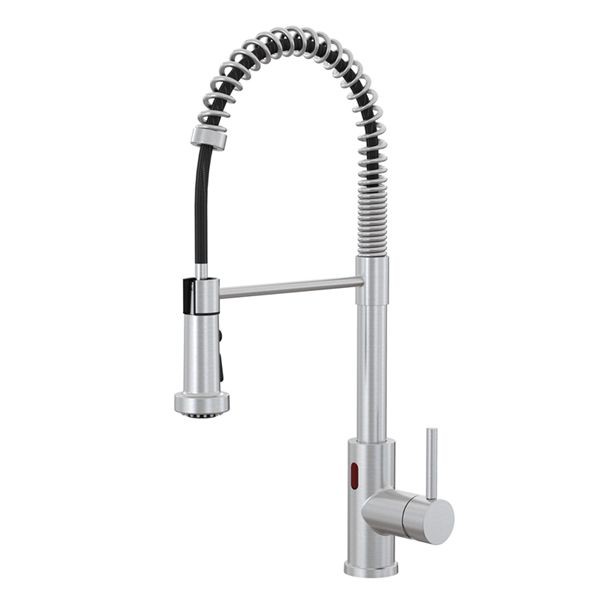
In addition to using top - notch technology and components, we conduct rigorous testing on all our faucets. Our quality control team tests each faucet for touch response time under different conditions to ensure that it meets our strict standards. We believe that by providing faucets with fast touch response times, we can offer our customers a superior product that will enhance their daily lives.
Comparing Our Faucets with Competitors
When comparing our touch sensitive faucets with those of our competitors, the difference in touch response time is often quite evident. Many of our competitors may use older or lower - quality touch sensor technologies, which result in slower response times. Some may also cut corners on the electronic components to reduce costs, sacrificing performance in the process.
Our faucets, on the other hand, are designed with the user in mind. We understand that a fast touch response time is crucial for a satisfying user experience, and we go the extra mile to ensure that our products deliver. Whether it's in a residential kitchen or a commercial bathroom, our faucets will provide a reliable and fast - responding solution.
Conclusion
In conclusion, the touch response time of touch sensitive faucets is a critical factor that affects the user experience, water conservation, and the durability of the faucet. As a supplier of Touch Sensor Kitchen Tap, we are dedicated to providing faucets with the fastest touch response times. We use the latest technology, high - quality components, and rigorous testing to ensure that our products meet the highest standards.
If you are in the market for a touch sensitive faucet, we invite you to consider our products. Our faucets offer not only a fast touch response but also a stylish design and reliable performance. We are always ready to discuss your specific needs and provide you with the best solutions. Whether you are a homeowner looking to upgrade your kitchen or a contractor working on a large - scale project, we can help. Contact us today to start a procurement discussion and find the perfect touch sensitive faucet for your needs.
References
- "Touch Sensor Technology: A Comprehensive Guide", Sensor Technology Press, 2020
- "Advances in Faucet Design and Technology", Plumbing Innovations Journal, 2021
- "Water Conservation through Smart Faucet Technology", Environmental Science Review, 2022